


When homeowners plan a flooring renovation, the vast majority of their time is spent debating between finishes like "Matte Honey Oak" or "Polished Graphite Slate." While the top layer provides the beauty, the most critical component of the installation is actually the layer you will never see: the subfloor. At Space Floors, we often tell our clients that a floor is only as good as the foundation it sits on. Ignoring subfloor preparation is the number one cause of flooring failure, leading to agonizing squeaks, unsightly cracks, and the premature degradation of expensive materials.
What Exactly Is a Subfloor?
The subfloor is the structural surface that rests directly on your home's floor joists. In most residential constructions, this consists of plywood or OSB (Oriented Strand Board). In many modern homes or apartments, the subfloor may be a concrete slab.
On top of the subfloor, we often install an "underlayment." This might be a thin layer of foam, felt, or cork. The underlayment serves three vital functions: it provides a moisture barrier, adds a layer of cushion for comfort, and acts as a sound-deadening membrane. Understanding the relationship between these layers is the key to a successful installation.
The Silent Killer: Subfloor Moisture
Moisture is the single greatest threat to any floor. For natural wood products, excess moisture in the subfloor can cause the planks to "cup" (where the edges are higher than the center) or "crown" (where the center bulges upward). Even with waterproof materials like vinyl, high moisture levels in a concrete slab can create hydrostatic pressure, which breaks down adhesives and leads to "bubbling" or mold growth beneath the surface.
Before any installation, our technicians perform rigorous moisture testing. We use calcium chloride tests or electronic moisture meters to ensure the subfloor’s "Relative Humidity" (RH) is within the manufacturer’s specified range. If levels are too high, a specialized moisture barrier or "sealer" must be applied before the flooring goes down.
The Importance of a Level Surface
No subfloor is perfectly flat. Over time, wood subfloors can sag between joists, and concrete slabs can develop "high spots" or "low spots" during the curing process. If you install a modern "click-lock" floor over an uneven surface, the joints will flex every time you walk across them. Over a few months, this constant stress will snap the locking mechanisms, leading to gaps and boards that "bounce."
Grinding: For concrete subfloors, high spots must be ground down using diamond-blade grinders.
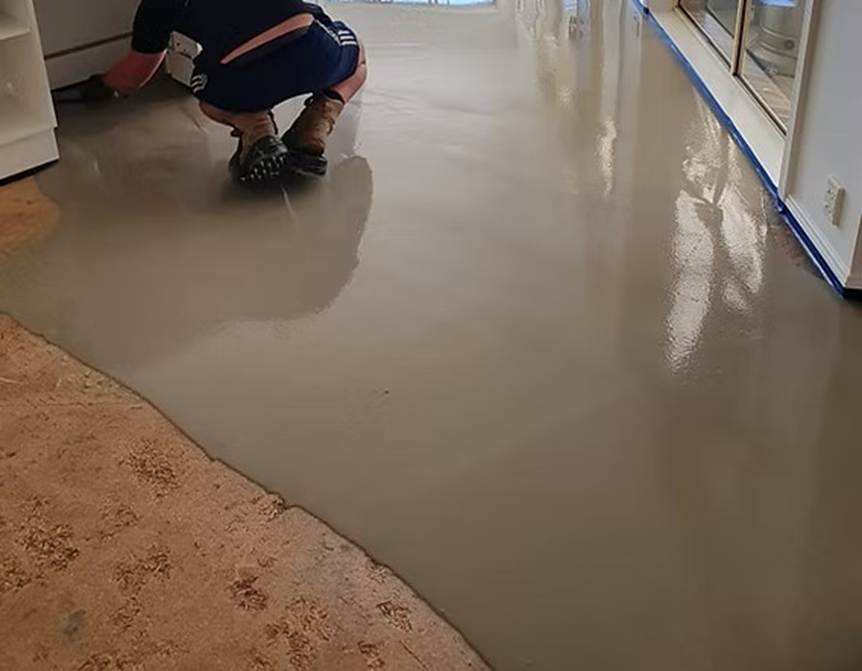
Self-Leveling Compounds: For low spots, we use advanced cementitious self-leveling underlayments. These products are poured as a liquid; they naturally seek the lowest points and harden into a perfectly level, glass-smooth surface that provides the ideal base for any flooring material.
Acoustic Insulation and Thermal Comfort
The subfloor preparation phase is also the best time to address "IIC" (Impact Insulation Class) ratings. If you are tired of hearing footsteps from the floor above, or if you live in a condo with strict noise ordinances, the choice of subfloor underlayment is critical. High-density rubber or cork underlayments can virtually eliminate the sound of dropped objects or heavy footsteps. Furthermore, in colder climates, adding an insulating underlayment can prevent the "heat sink" effect, where a cold concrete subfloor sucks the warmth out of your living space.
Why Professional Preparation Saves Money
Many "budget" contractors will try to skip the subfloor preparation phase to offer a lower quote. They might simply lay the new floor over the old one or ignore a slight dip in the plywood. This is a classic example of being "penny wise and pound foolish." The cost of ripping up a failed floor two years later is significantly higher than the cost of doing the subfloor preparation correctly the first time.
Our Commitment to Structural Integrity
We pride ourselves on our meticulous, science-based approach to flooring. We don't just "lay boards"—we engineer a surface that will last for a generation. To understand our core values and our dedication to technical excellence, we encourage you to read more About Us.
If you are planning a renovation and want to ensure it is done right from the ground up, visit us at our Location. Our experts will walk you through the preparation process and help you choose the right materials for a lifetime of durability.


